Every notebook in this book uses llm_cascade for automatic LLM provider fallback. Here’s a quick reference.
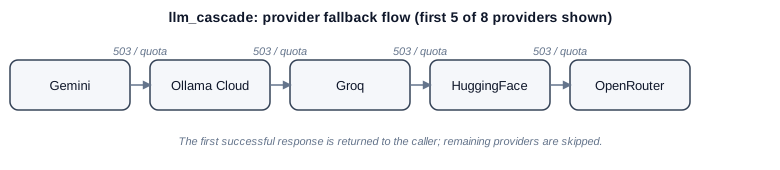
Figure 1:How llm_cascade cascades through providers: the first to succeed returns the response; a 503, 429, or quota-exceeded error on one provider falls through to the next. The cascade tries all 8 providers in order; only the first five are shown here.
As shown in Figure 1, your notebook call never has to know which provider ultimately served the response — response.provider tells you after the fact.
Install
pip install git+https://github.com/KarAnalytics/llm_cascade.gitQuick start
from llm_cascade import get_cascade

llm = get_cascade()                          # auto-detects your API keys
response = llm.generate("What is Python?")   # falls back if one provider is down
print(response.text)                         # the answer
print(response.provider)                     # which provider answered (e.g., "Gemini")
print(response.model)                        # which model was used
Supported providers
| Provider | Env Variable | Free Tier |
|---|---|---|
| OpenAI | OPENAI_API_KEY | Limited free credits |
| Gemini | GEMINI_API_KEY | 500 req/day |
| Ollama Cloud | OLLAMA_API_KEY | Free tier |
| Grok (xAI) | XAI_API_KEY | $25/month free |
| Groq | GROQ_API_KEY | 30 req/min |
| HuggingFace | HF_TOKEN | Free inference |
| Cohere | COHERE_API_KEY | 20 req/min |
| OpenRouter | OPENROUTER_API_KEY | Free models |
Set any key in your .env file or Colab Secrets. The cascade tries them in order and falls back automatically on quota errors, auth failures, or server outages.
Override models per notebook
llm = get_cascade(models={"Gemini": "gemini-2.5-pro", "OpenAI": "gpt-4o"})
# or after creation:
llm.set_model("Gemini", "gemini-2.5-pro")
Embeddings (local, no API key needed)
embedding = llm.get_embedding("some text") # uses all-MiniLM-L6-v2 locally